
Books I Enjoyed In 2025

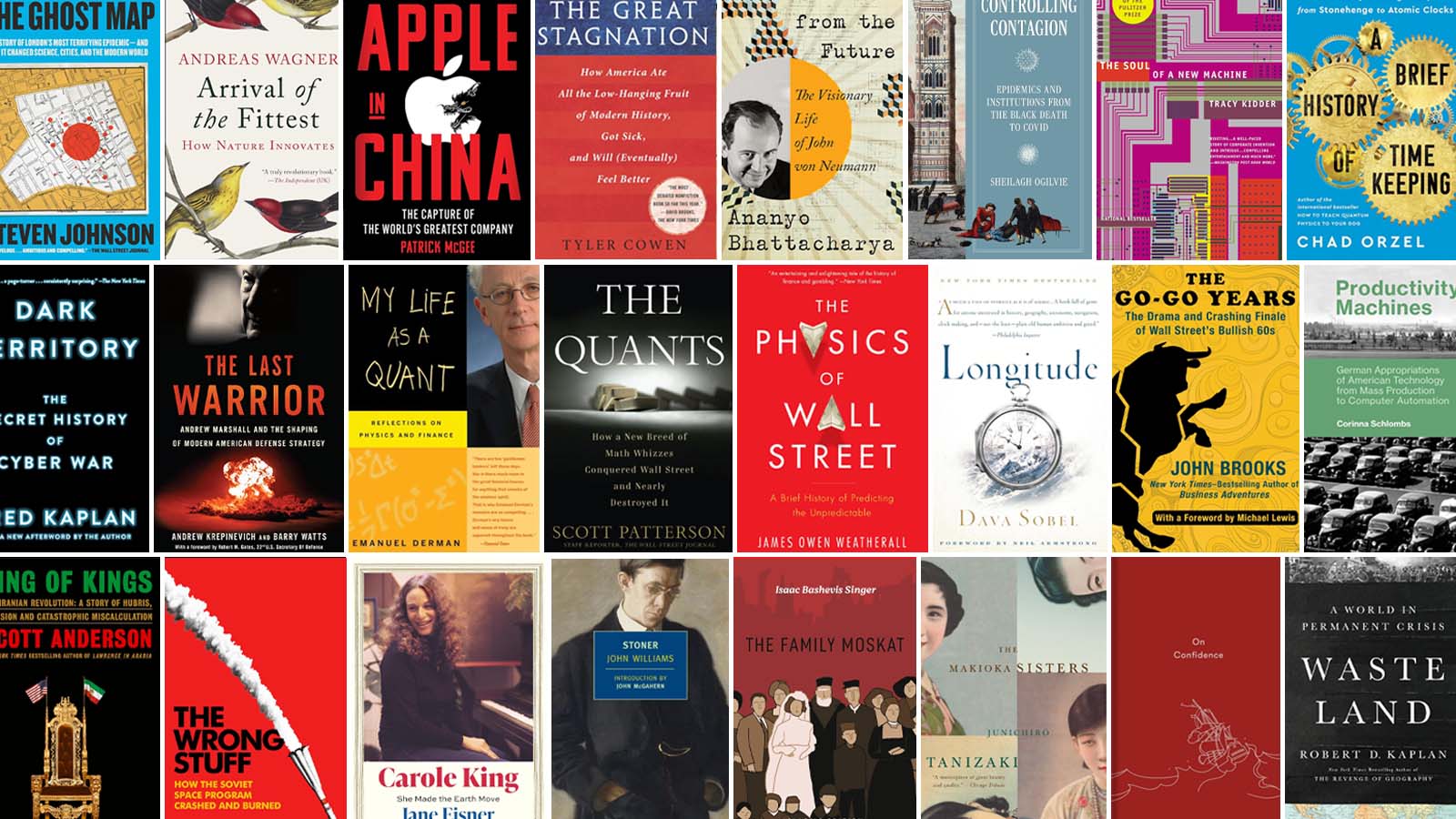
Below are books I read and enjoyed this year, not necessarily for the first time. The list includes books I took many notes on, meaning I found them worthwhile. I included affiliate links to Amazon in case you'd like to explore further. As an affiliate, I earn a small commission on any book sold.
While we're talking about books: I recently signed a deal with Simon & Schuster to publish my next one. My editor is the great Eamon Dolan, and the working title is Nonlinear.
What is the book about? In short:
The old link between effort and reward is broken. The uncertainty, inequality, and jackpot dynamics of show business are spreading across the economy, making all career paths more scalable and more risky.
Why is this happening? How can we make the most of it?
Nonlinear explores the personal heuristics, management methods, and investment strategies that work now and in the immediate future.
I plan to complete the book in a few months, which means it will be published in early 2027. Those of you who pledged your support for my original second book project will be gifted a copy, as promised. Thank you again!
And now, for some books I enjoyed in 2025, organized by topic.
Technology & Innovation
Apple in China: The Capture of the World's Greatest Company. A truly masterful account of how Apple shaped and enhanced China's technology sector and manufacturing base. The core subjects — China and Apple — are fascinating in their own right. But the book offers so much more: A history of technology, globalization, and geopolitics from 1980 to today.
...demand from China’s 1.4 billion people indirectly supports... between 1 million and 2.6 million jobs in America; whereas... Apple alone supports 5 million jobs in China... That upside-down contrast boggles the mind: one super-corporation has more of an impact on job creation in China than all of China has on America.
The Soul of A New Machine: Tracy Kidder's classic account of the early days of personal computing.
By the mid-1960s, a trend that would become increasingly pronounced was already apparent: while the expense of building a computer’s hardware was steadily declining, the cost of creating both user and system software was rising.
The Great Stagnation: How America Ate All The Low-Hanging Fruit of Modern History, Got Sick, and Will (Eventually) Feel Better. Tyler Cowen's modern classic about why advanced economies struggle to maintain the pace of innovation. Particularly interesting to revisit now, when we might be finally on the cusp of a new wave of dramatic innovations and radical changes to basic costs.
People often blame the economic policies of "the other side" or they belligerently snipe at foreign competition. But we are failing to understand why we are failing. All of these problems have a single, little noticed root cause: We have been living off low-hanging fruit for at least three hundred years. We have built social and economic institutions on the expectation of a lot of low-hanging fruit, but that fruit is mostly gone.
Longitude: The True Story of a Lone Genius Who Solved the Greatest Scientific Problem of His Time. How a self-taught clockmaker defied the scientific and political elite changed the world.
King Louis XIV of France, confronted with a revised map of his domain based on accurate longitude measurements, reportedly complained that he was losing more territory to his astronomers than to his enemies.
A Brief History of Timekeeping: The Science of Marking Time, from Stonehenge to Atomic Clocks. A book about how new ways to measure time reshaped science, commerce, and reality itself.
...the process of synchronizing two clocks at different locations through the exchange of telegraphic signals was central to the development of the theory of relativity, with momentous consequences for our understanding of time and space.
Productivity Machines: German Appropriations of American Technology from Mass Production to Computer Automation. Officially, a book about Germany's complicated relationship with American industrial methods. But, in essence, a book about the invention of "productivity" as an economic concept: How it was measured, for what purpose, and what role did it play in politics and labor relations.
For most of the nineteenth century, Americans had upheld the idea of small, independent producers—such as farmers or cabinetmakers—who formed the basis of a democratic republic founded on independent citizens. They viewed wage labor—working by the hour for someone else—as something acceptable only on a temporary basis; wage labor was seen as “slave labor” or “prostitution.”
The Man from the Future: The Visionary Ideas of John von Neumann. A biography of the polymath who invented game theory, architected modern computers, and facilitated the atomic age.
In 1910, a quarter of Budapest’s population, and more than half of its doctors, lawyers and bankers, were Jewish, as were many of those involved in the city’s thriving cultural scene.
Finance & Markets
My Life as a Quant: Reflections on Physics and Finance. A physicist's journey from academia to Wall Street's mathematical frontier.
I came to see that creating a successful financial model is not just a battle for finding the truth, but also a battle for the hearts and minds of the people who use it. The right model and the right concept, when they make thinking about value easier, can stick and take over the world.
The Quants: How a New Breed of Math Whizzes Conquered Wall Street and Nearly Destroyed It. On the rise and rise of computerized stock and bond trading.
The rise of the personal computer, increased volatility due to fluctuating inflation and interest rates, and options and futures exchanges in Chicago and New York created the perfect environment for the brainiacs from academia. Physicists, electrical engineers, even code breakers trained by the military-industrial complex found that they could use the math they’d always loved to make millions in the financial markets.
The Physics of Wall Street: A Brief History of Predicting the Unpredictable. A journey through the scientific ideas that transformed markets—for better and worse.
Much of the [RenTech's] advantage comes from the quality of the people who work there—they are, by all accounts, simply smarter than most other quants. But equally important is the way the firm is structured: it has a large group of dedicated researchers who are given forty hours a week of unstructured time during which they are encouraged to pursue their own ideas.
The Go-Go Years: The Drama and Crashing Finale of Wall Street's Bullish 60s. A fun account of Wall Street's wild 1960s boom and its inevitable crash. Lesser known than 1929 or 2008, but equally instructive.
...at the height of the 1929 boom... there were only 4 or 5 million Americans in the stock market. In the summer of 1970 the Stock Exchange proudly unveiled a survey showing that the country now held over 30 million shareowners. “People’s capitalism” had arrived, then, and there were figures to prove...
Evolution & Pandemics
Arrival of the Fittest: Solving Evolution's Greatest Puzzle. Most accounts of evolution focus on selection between a variety of options. This book focuses on the mechanisms that generate that variety, and how they inform our thinking about innovations in other fields.
Microwave ovens heat food with a technology originally developed for radar—a radar engineer discovered its heating powers when it melted a chocolate bar in his pocket. (The first commercial version was called the “Radarange.”)
The Ghost Map: The Story of London's Most Terrifying Epidemic — and How It Changed Science, Cities, and the Modern World. The great Steven Johnson with an old story that resonates with current problems.
Waste recycling turns out to be a hallmark of almost all complex systems, whether the man-made ecosystems of urban life, or the microscopic economies of the cell.
Controlling Contagion: Epidemics and Institutions from the Black Death to Covid. A somewhat academic account of the interaction between politics, markets, and pandemics.
The best-known commercial variolator in England was the Suffolk apothecary Robert Sutton, whose son had contracted severe smallpox from being variolated by a neighbour in 1756. Sutton saw a gap in the market and systematically remedied it. He tempted customers by offering a simplified procedure, minimal scarring, residential care packages, nurses with good reputations, and lower prices than many medically supervised variolation procedures. Sutton’s eight sons all set up as commercial variolators.
Defense & Geopolitics
The Last Warrior: Andrew Marshall and the Shaping of Modern American Defense Strategy. The story and ideas of one of the most influential and least known "players" behind America's Cold War and post-Cold War military strategy.
While it was natural to assume that an organization’s decisions generally were made at the top and flowed down its formal chain of command, in reality, informal bureaucratic structures also served to process information that influenced the organization’s strategic choices. Such findings confirmed Marshall and Loftus’s growing doubts about the ability of any large organization to act as a unitary, rational actor.
Dark Territory: The Secret History of Cyber War.What it says on the tin. The use of computers and communication networks for geopolitical and military advantage from the early 20th Century until today.
The KGB suspected something peculiar was going on up there. On January 20, 1978, Bobby Ray Inman, the NSA director, was awakened by a phone call from Warren Christopher, the deputy secretary of state. A fire had erupted in the Moscow embassy, and the local fire chief was saying he wouldn’t put it out unless he was given access to the tenth floor. Christopher asked Inman what he should do. Inman replied, “Let it burn.”
Waste Land: Robert D. Kaplan on the unraveling of global order. Some repetition or variation of Kaplan's earlier work, but always enjoyable and often insightful.
The entire world is one big Weimar now, connected enough for one part to mortally influence the other parts, yet not connected enough to be politically coherent.
King of Kings: The Iranian Revolution: A Story of Hubris, Delusion and Catastrophic Miscalculation. The rise and fall of Iran's last Shah, and the friends who helped him stay in power and failed to save him when he needed them most.
Over the span of the shah’s rule, per capita income had increased a phenomenal twenty times over, the literacy rate had quintupled, and the average lifespan of an Iranian had more than doubled from twenty-seven to fifty-six.
The Wrong Stuff: How the Soviet Space Program Crashed and Burned. A wild and funny account of the USSR's chaotic efforts to outshine America.
Mercury astronauts enjoyed the luxury of splashing down softly in the ocean, because the U.S. was surrounded by temperate waters and had a very large navy for retrievals. Thus Cape Canaveral. The Soviets, with their mania for secrecy, put their Cosmodrome out in the middle of nowhere, where activities and especially failures were far from prying eyes... The Cosmodrome was surrounded by vast tracts of steppe and forest, so that’s where Vostok capsules came down. They were hard landings that could kill any cosmonaut inside, and eventually did.
Fiction & Misc.
On Confidence: Alain de Botton's short meditation on why we doubt ourselves more than we should. Quick read. Simple and to the point. Worth revisiting whenever you need a little confidence boost.
We know ourselves from the inside, but others only from the outside. We are aware of all our anxieties and doubts from within, yet all we know of others is what they happen to do and tell us...
Carole King: She Made the Earth Move. The story of a songwriter who shaped the sound of American pop. And so much more: a history of popular music and the modern entertainment industry, a story of Jewish migration and social mobility, a story of Black music and musicians and their interactions with Jewish musicians and the american mainstream.
The transistor radio, developed just after World War II, became widely available in a compact five-inch version in 1954. Until then, listening to recorded music was a communal activity, controlled by those who controlled the family radio, and who owned the record players and the records themselves.
Stoner by John Williams: A classic American novel about the life of a mediocre literature professor in the early 20th Century. It doesn't sound like much, and not much happens. But the writing and atmosphere are exquisite.
...they talked quietly and casually, as if they were old friends or exhausted enemies.
The Family Moskat: Isaac Bashevis Singer follows a Jewish family in Poland from the late 19th Century until the eve of World War II, with deafening echoes of today's internal and external debates about Judaism, Zionism, Antisemitism, Socialism, and War.
"Ideas! The whole world's busy with ideas," Dacha put in with a sigh. "My Hadassah—every day she's writing down her ideas. In my time nobody bothered with ideas and we lived just the same."
Moskat reminded me of one of my favorite novels, Tanizaki's The Makioka Sisters. Both books describe upper-middle-class families grappling with cultural and economic change, oblivious to much larger threats. As we worry about upgrading our houses and marrying off our children, external events occasionally wipe out whole communities and ways of living.
And on this somber note, I wish you a healthy and happy 2026, a year full of good news, optimistic assumptions, and — if it's not too much to ask — a few miracles.
What's the best book you read this year?
Best,

P.S.
🎧 I recently chatted — in Hebrew — with Haaretz's Haim Handwerker about Mamdani's NYC, Israel's war in Gaza, antisemitism, and my own personal journey and adventures. You can listen on Spotify, Apple Podcasts, Amazon Music, and beyond.
🎤 How will AI reshape our cities, companies, and careers? My speaking schedule for 2026 is filling up. Visit my speaker profile and get in touch to learn more.
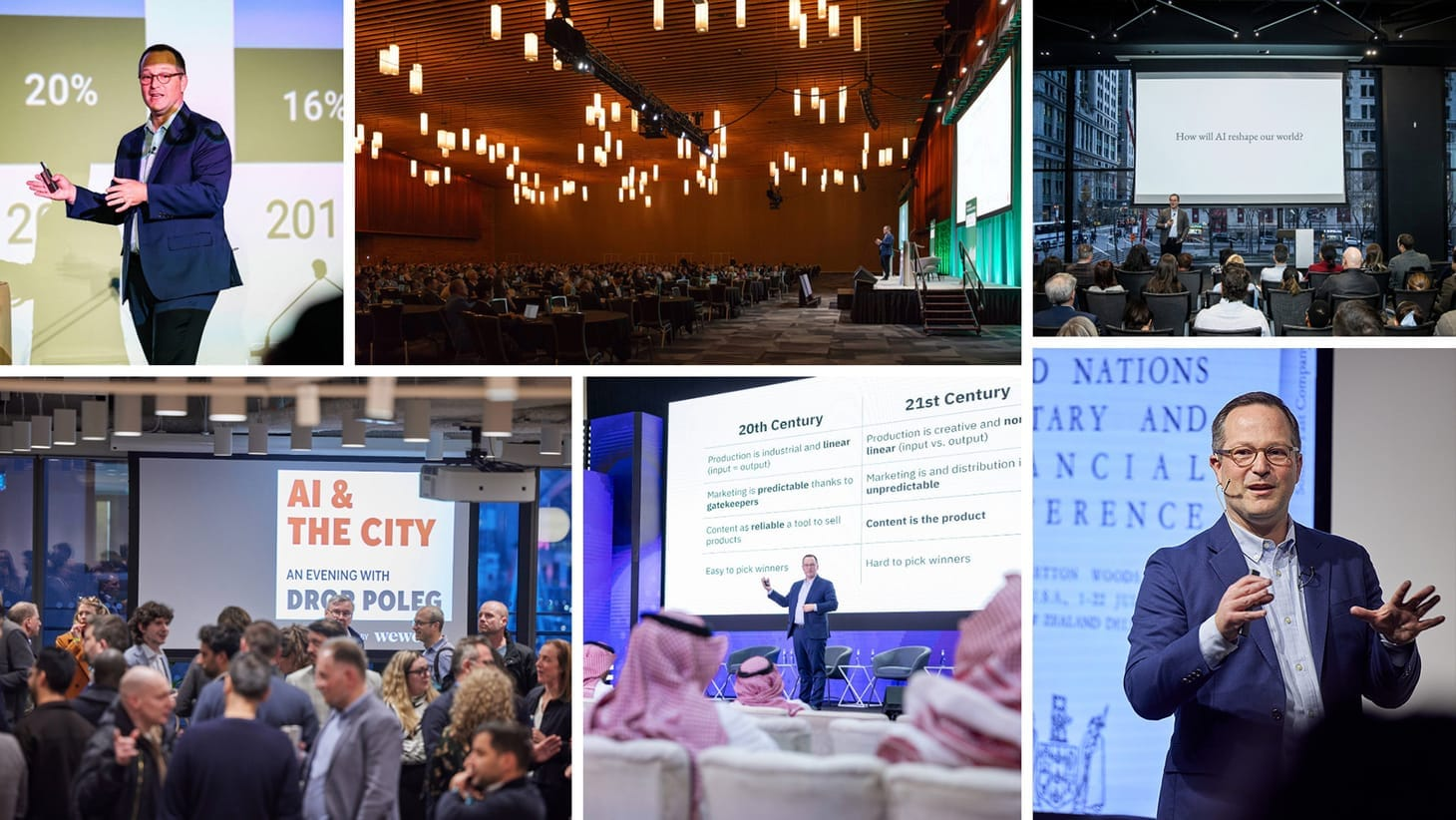
Click here to book a keynote or learn more.


Old/New by Dror Poleg Newsletter
Join the newsletter to receive the latest updates in your inbox.