The Meaning Of Dubai
The Middle East's great cities need a purpose. They don't need to look too far to find it.


The Middle East is in flames. And this time, a lot of Iran’s missiles and drones are aimed at its neighbours along the Arabian coast. Over at The New York Times, my friend Richard Florida poses an arresting question: Could this be the end of Dubai?
More broadly, Florida writes about the growing disconnect between people and place, especially well-paid professionals and the international cities that accommodate them. Dubai is probably the most extreme example of this disconnect:
“Nearly nine in 10 Dubai residents are nonnationals — by far the highest percentage of any major city in the world. Across the Emirates as a whole, about 10 million of 11.4 million residents are foreign nationals.”
The city prides itself on being friendly to business and expats, on having low taxes and fewer obstacles to running a business, and on being laser-focused on making life safe, comfortable, and fun for anyone with capital — human or otherwise. Dubai’s success inspires other cities to compete for the same, well, customers:
“Riyadh, Saudi Arabia; Istanbul; Miami; and Doha, Qatar — are attempting to adopt some variation on the same basic formula to compete for the same class. But that duplication also means these cities can be replaceable. If one falters, another steps up to take its place.”
As I have written previously, even New York City is threatened by the same dynamics: physical locations are becoming consumer products — places that individual people choose to spend time in, even though they can be anywhere else. This choice applies to specific buildings, individual neighborhoods, and whole cities and states.
But, as Florida points out, cities like New York and London have residents with deeper roots and have stories that people can relate to:
“To say ‘I am a New Yorker’ or a Londoner or ‘I am from Pittsburgh’ or Detroit or Rome or Barcelona — that is not just a map. It conveys a deep sense of history, belonging and meaning, a personal identity, not just a transaction. Those identities are messy and unequal, but they are substantial. They are one of the primary ways people answer the basic questions of who they are and where they belong. And they are part of what brings people back to hang on and rebuild, no matter what.”
For a city to rise up again and again, it is not enough to have low taxes and shiny condominiums. Place needs to be tied to meaning and purpose.
Another Middle Eastern city shows what this means in practice. Consider this report from Reuters:
“More than 20,000 Israelis have returned to the country since the start of the Iran air war that began on Saturday, the Transportation Ministry said last week, adding that about 120,000 more Israelis currently abroad are seeking to come home.”
This kind of attachment can be tribal, irrational, sometimes even destructive. But it is also the thing that holds a city together when everything else falls apart. Israel is an example of how place, purpose, and meaning can be tied together so strongly that people run back into Tel Aviv once missiles start falling.
Can other cities in the Middle East develop a similar sense of purpose?
They can, and they must.
What makes a place attractive to people who can live anywhere?
The first part of the answer focuses on each place’s functional aspects. In a world of consumer choice, locations must think like consumer products. One way to win is to double down on what only the biggest cities can offer—walkable streets, car-free transportation, and cultural and intellectual diversity. But smaller cities can emphasize shorter commutes, ample parking, proximity to nature, better schools, and lower taxes.
But the second part is more important. The best consumer brands go beyond addressing their customers’ functional needs and preferences. They appeal to the customer’s values and aspirations. The highest level is making the customer feel like they’re active contributors to something big and meaningful — to feel like they are making the world better by buying your product.
Cities and regions need to think along the same lines. They need to seek meaning and tap into the values and aspirations of their potential customers — residents, investors, and tourists. They need to come up with a big idea that people would want to contribute to. They need to come up with a story and invite people to be a part of it.
What could this story be for cities in the Middle East? What is that one thing that people can aspire to contribute to?
Two and a half years ago, I spoke in Riyadh about this exact question and offered a possible answer: peace. If people feel that their presence contributes to bringing stability and peace to the Middle East, they will spend more time here. Simply the fact that a Lebanese restaurant owner, an Iranian architect, an Israeli entrepreneur, and a Palestinian consultant can sit in the same Dubai café, doing ordinary work on an ordinary Tuesday. Peace isn't only about slogans and treaties. It's also normalcy at scale.
The massive investment in the region has to be tied to real change. This means economic opportunities for the tens of millions of young men and women, a just solution for all the refugees in the region, and infrastructure and real estate projects that serve real people, not just outside investors or Instagram posts.
Even Israel, the region's clearest example of attachment to place, is paying a price for the absence of peace. According to Israel's Central Bureau of Statistics, the country has crossed into a negative migration balance for academics — more are leaving than coming back. A quarter of Israelis with a PhD in mathematics now live abroad, and so do more than a fifth of those with PhDs in computer science. A country can survive on purpose for a long time. It cannot thrive indefinitely by asking its most educated and mobile citizens to raise families under missile fire — especially when many of them increasingly see these wars as political choices rather than necessities.
A few weeks after my talk in 2023, Benjamin Netanyahu spoke at the UN, gloating that Israel was about to sign a normalization deal with Saudi Arabia while ignoring the Palestinian issue. During the same week, Saudi Arabia’s Mohammed bin Salman indicated that he was indeed ready to proceed with tightening economic and diplomatic ties with Israel.
A few days later, on October 7, 2023, Hamas terrorists stormed into Israel and derailed Netanyahu and MBS’s plan. The violence and chaos that ensued have reshaped the Middle East: Gaza is in ruins; Israeli cities remain under constant threat of missiles from all directions; and now Dubai and other Gulf cities are under fire and fighting to maintain their image as safe havens for human and financial capital.
The need for a regional peace plan has never been greater. We find it so easy to fight wars. When one war fails, we assume that another war would surely do the trick. And then another. But when peace fails once, we somehow assume it should never be pursued again. That is a wrong assumption.
The Middle East needs peace between Israelis and Palestinians, Lebanese, Syrians, and everyone else. Iran can join too, when it’s ready. But the rest of the region can no longer afford to be so disjointed. The will to pursue it anyway — to try again after catastrophic failure — is exactly the kind of courage that changes history.
And it would give Gulf cities something missiles have exposed they never had: a story worth being part of. Not a tax rate. Not a skyline. A purpose. That is what turns a platform into a place, and a resident into someone who stays.
So, to answer The New York Times’s question: Could this be the end of Dubai?
No, it can’t be. We can’t let it be. The latest attacks should reinforce the city’s purpose as a beacon of cooperation, as an example of how things can be different, as a center for renewed efforts to engage with the region’s challenges rather than gloss over them.
There is no greater purpose than peace. And there is no more important place to pursue it than the Middle East. I’d build a city on that.
Best,

🎤 How will AI reshape our cities, companies, and careers? My speaking schedule for the summer is filling up. Visit my speaker profile and get in touch to learn more.
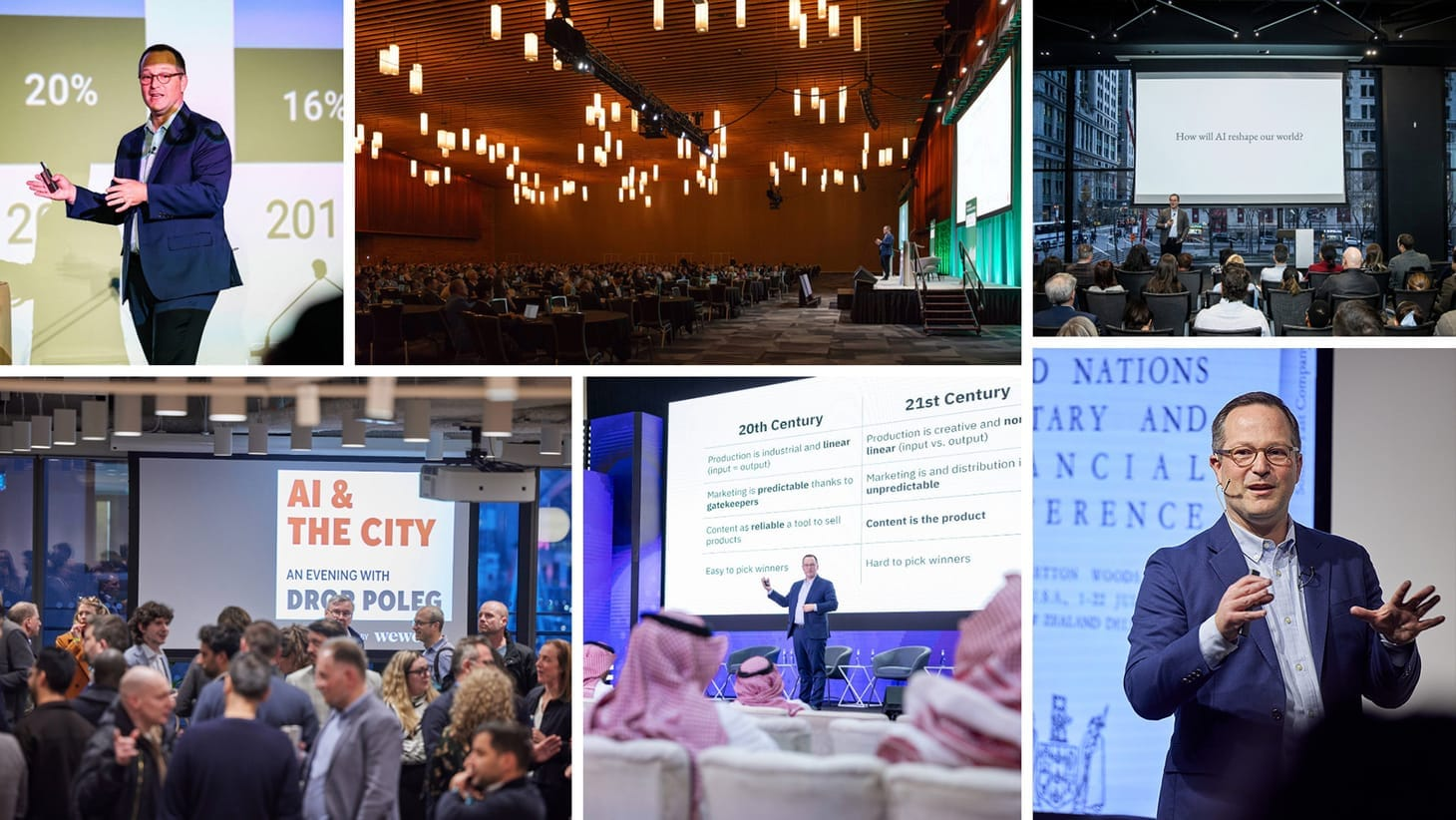
Click here to book a keynote or learn more.
Old/New by Dror Poleg Newsletter
Join the newsletter to receive the latest updates in your inbox.